



Moodle LMS for Hospitals and Healthcare Organisations
IWIS builds, implements and adapts Moodle LMS for hospitals, clinics and pharmaceutical companies: staff training, continuing professional development, onboarding, testing and certification, reporting and integrations
Discuss a Moodle projectMoodle LMS for training medical staff
A medical LMS is not a separate medical product but the same open-source learning management system. There is no distinct «medical» build: Moodle for hospitals is the same Moodle. The LMS platform for healthcare facilities is configured around one specific structure — departments and branches, categories of staff, access rules, reporting requirements.
A single healthcare LMS covers the full cycle: training of medical staff, continuing professional development, onboarding, testing and assessment, a library of protocols and analytics. Moodle for healthcare organisations is deployed inside your own infrastructure, so data about staff never leaves the perimeter of the organisation.
IWIS is responsible for the technology: development, implementation, customisation and integration. The content of the programmes, their accreditation and professional certificates are provided by the organisation or its educational partner, while LMS healthcare software gives the environment and verified completion data. The general capabilities of the platform — Moodle LMS for business.

Your structure, not a template
Course categories and groups follow the actual structure: departments, branches, individual clinics in a network. A new department is added as a configuration change, not as a separate project.

Roles that match real positions
Administrator, training manager, head of department, senior nurse, doctor, intern. Each role sees exactly the data its function requires.

Training that ignores the shift rota
Distance learning for medical staff removes the main constraint of a hospital: you cannot put the night shift and the day shift in one room. The material is available when the employee can work through it.

The platform belongs to you
Moodle is distributed under the GPL: no per-user fee and no limit on courses. The LMS for healthcare facilities runs on the organisation’s own infrastructure.

From one department to a whole network
The platform works the same for a hundred employees in one clinic and for a network of centres across several cities sharing one library of materials.

Local language and mobile access
The interface runs in the local language and, where needed, a second one in parallel. Courses are taken from a phone, so learning is not tied to the computer in the staff room.
5 signs a healthcare organisation needs its own learning platform
The need for an LMS for hospitals becomes obvious not when a budget appears, but when training does happen and there is nothing to prove the result.
What a learning platform for medical staff looks like from the inside
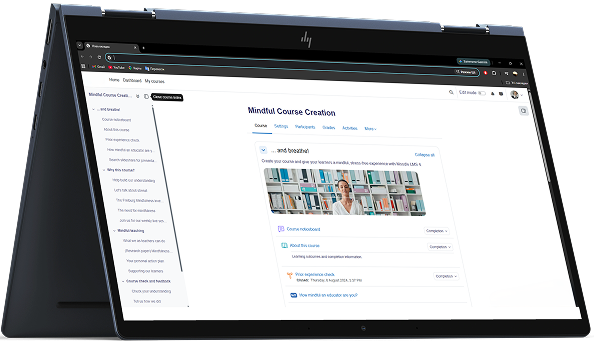
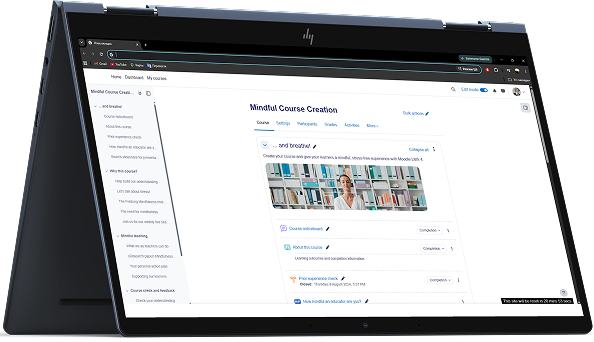
A course of protocols, video and practice
Updating materials without a developer
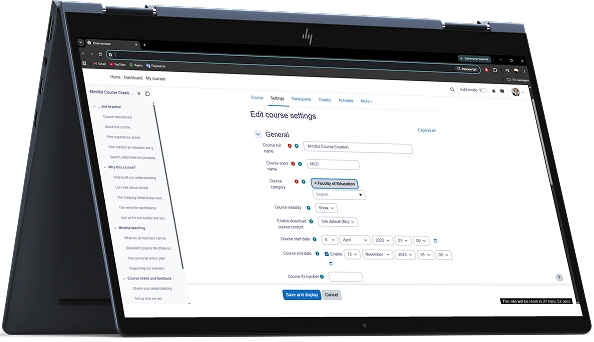
Course settings and a second language
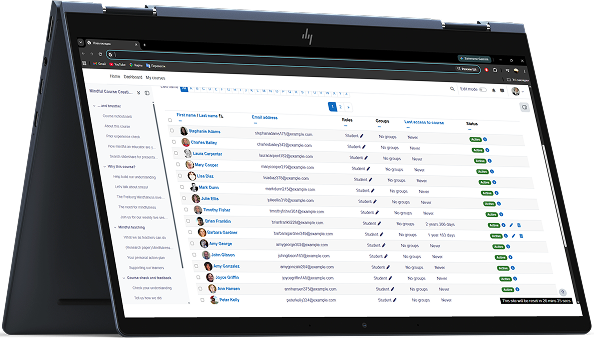
Administration, roles and permissions
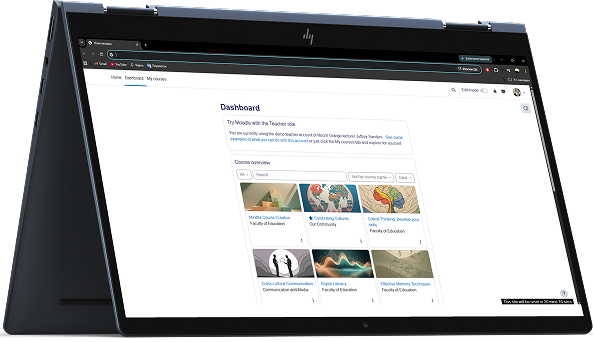
One space for the administrator and the doctor
What Moodle LMS covers in a healthcare organisation
The scope of a project always starts from what the organisation already has: materials and protocols, current procedures, internal systems, reporting requirements.
Continuing professional development and distance learning
Continuing professional development for doctors requires evidence: who completed the programme, when and with what result. Moodle is the platform where the training of medical staff is planned, delivered and recorded, while distance learning for doctors removes the tie to the shift rota and to one city.
- Learning paths by position and speciality; upskilling plans for medical staff with deadline control.
- Access from the staff room, from home and from a phone — the same course and progress, so online training for doctors does not depend on who is on duty.
- Step-by-step release of topics and progress tracked per element, so online training of doctors is visible in detail.
- Training history for any period, without consolidating spreadsheets by hand.
Upskilling courses for doctors and for other categories of medical staff are authored by the organisation or its educational partner: IWIS does not deliver medical courses and does not accredit CPD.

Onboarding and adaptation of new employees
The adaptation of new hospital staff stops depending on how busy the mentor is: the induction programme is assigned automatically on the first day and is identical for everyone in that position.
- Onboarding of medical staff by role: doctor, nurse, reception administrator, laboratory technician.
- Internal rules, patient care standards, sanitary requirements, work with the medical information system.

Testing, assessment and certification
Testing of medical staff should produce not a tick in a box but a verifiable fact: who passed, when, on which attempt and with what score.
- A question bank with random selection, a time limit and a limited number of attempts.
- Periodic assessment of medical staff on a schedule — the test is assigned automatically.
- Certification of medical staff inside the organisation: a personalised record is generated once the conditions are met.
That document confirms an internal programme of the organisation; state and professional certificates are issued by authorised bodies.

Control, reporting and learning analytics
Control over the training of medical staff is why LMS systems for healthcare get implemented at all: a report should take minutes to produce rather than being assembled from departmental spreadsheets.
- Progress and course completion by department, branch, position and employee.
- Custom reports matching the organisation’s internal forms, ready for export.
- Scheduled automatic delivery of reports and export to a BI system.

Moodle LMS for pharmaceutical companies: training and compliance
A pharmaceutical LMS solves a problem a hospital does not have: training a distributed team where representatives work in the field, manufacturing follows its own standards and quality assurance a third set. Moodle for pharmaceutical companies brings those programmes into one system with unified reporting, which is why an LMS for pharma is more often built on an open platform.
- Pharmaceutical training by role — training of pharmaceutical company staff: manufacturing, quality control, R&D, marketing, medical affairs, distribution.
- Pharmaceutical sales rep training: product knowledge, ethics of communication with doctors, a knowledge check before going into the field.
- Pharmaceutical training courses for every product launch, and several languages in one system for international teams.
- Pharmaceutical compliance training: GMP training for manufacturing and warehouse staff and GxP training for roles working with data and documentation, repeated on a schedule.
- Internal policies and SOPs with a record of acknowledgement, the document version and status by department.
For Servier we rebuilt the reporting system and for Yuria-Pharm we designed a new data architecture — we know the industry from practice. Conformity with regulatory requirements, including computerised system validation, is defined separately, with your quality department.

Integrating and customising Moodle for your processes
The platform is useful when it does not become yet another system with a separate login and list of employees. Integrating Moodle with internal systems removes manual user management, while customising Moodle for a healthcare facility brings the platform’s scenarios in line with the organisation’s processes: healthcare LMS software is rarely implemented as-is.
- Single sign-on through the corporate account: Active Directory, LDAP or SSO.
- Synchronisation of employees and departments from the HR system: hires, transfers and departures reach the LMS automatically.
- Data exchange through the REST API, webhooks or middleware; results pushed to an internal portal or a BI system.
- Roles and permissions for real positions, including non-standard ones.
- Module and plugin development: custom report formats, non-standard course assignment scenarios, access rules.
In an LMS project for a leading Ukrainian bank it was the integration that produced the main effect: employees sign in with their corporate account and the user base is no longer maintained by hand. We write code to the platform’s standards rather than patching the core.

Stages of a Moodle LMS rollout in a healthcare organisation
Implementing Moodle is not installing software. Before the first course exists we work through the roles, the sources of employee data and the requirements the platform has to meet inside the organisation.
Requirements analysis
We look at how training happens today: who prepares the materials, how completion is recorded, which reports management needs, which positions and departments the healthcare LMS has to cover. If an installation already exists, we assess its version, stack and data.
Platform design
We fix the course structure, roles and permissions, learning paths by position and the list of reports. This is where it becomes clear what configuration can cover and what needs custom development.
Configuration and development
We deploy the platform in the organisation's infrastructure, configure roles and learning scenarios and bring the interface to the required style and languages. Module and report development runs in parallel.
Integrations and migration
We connect the user directory for single sign-on and other internal systems. Existing courses, materials and completion history are migrated with verification on a test environment.
Launch and support
We verify learning scenarios, access rights, performance and the correctness of reports, then move the platform into production. Moodle support then runs under an SLA: security updates, monitoring and enhancements on request.
Which healthcare organisations Moodle LMS suits
Hospitals and multi-speciality inpatient facilities
A hospital LMS for a facility with many departments: a dedicated programme for each staff category, a shared library of protocols, shared reporting.
Private clinics and medical centres
Moodle for clinics: patient care standards, onboarding, regular knowledge checks, service quality control.
Networks of clinics and medical centres
An LMS for healthcare organisations with branches: a central library of materials, the same level of preparation at every location, separate rights for managers.
Pharmaceutical companies
An LMS for pharmaceutical companies: training for manufacturing, quality assurance, marketing and medical reps, compliance programmes and analytics by region.
Diagnostic and clinical laboratories
Training on equipment and methods, biosafety briefings and knowledge checks before clearance.
Dental and rehabilitation networks
Moodle for smaller healthcare facilities: induction programmes, procedure protocols, completion tracking.
Medtech companies and equipment distributors
Training for the service team and for customers: how to operate the equipment, what to do when it fails, proof of completion before access to the hardware.
Frequently asked questions about Moodle LMS for hospitals and healthcare organisations
Which healthcare organisations does Moodle LMS suit?
The platform has no industry restrictions, so it is used equally by hospitals and multi-speciality inpatient facilities, private clinics and medical centres, networked healthcare organisations with branches in several cities, diagnostic laboratories and pharmaceutical companies.
Size is not an obstacle either: an LMS system built on Moodle works for a single department of a hundred people and for a network with thousands of users. The difference between those cases lies in the course structure, the roles and the scope of integrations, not in the platform itself.
Can Moodle be used for continuing professional development of doctors?
Yes — as the technology platform for organising such programmes. Moodle supports individual learning paths by position and speciality, annual plans with deadline control, automatic reminders about unfinished programmes and a full training history for any period.
There is an important boundary: IWIS does not deliver medical courses, does not issue professional certificates and does not accredit CPD programmes. The content is prepared by the organisation itself or by its educational partner, while the platform provides the environment, completion control and verified data about the result.
Can distance learning be organised for medical staff?
Yes, and this is most often the reason for implementing a platform in the first place. Staff work shifts and some of them sit in branches, so gathering everyone in one room is impossible. An online course is tied to the person rather than to a date and a place: the employee logs in from the computer in the staff room, from home or from a phone, and sees the same progress.
A course can contain video, documents, images, links and interactive H5P exercises, and topics can be released step by step. Progress is recorded for each element, so it is visible not only that a course was finished but exactly where an employee stopped.
Is Moodle suitable for onboarding new hospital staff?
Yes. The induction programme is assigned automatically on the day of hire and runs identically for everyone in that position — separately for a doctor, a nurse, a reception administrator or a laboratory technician.
The programme covers internal rules, patient care standards, sanitary and anti-epidemic requirements, work with the medical information system and equipment operating instructions. It ends with a test and a record of clearance for independent work, which makes the adaptation period manageable instead of dependent on how busy the mentor is.
Can testing and certification of employees be run in Moodle?
Yes. The platform supports a question bank with random selection, time limits and a capped number of attempts, different task formats — from single choice to clinical scenarios with detailed marking — and periodic scheduled assessment with automatic test assignment.
Once the conditions are met, the system generates a personalised record of completion of the organisation's internal programme. That is confirmation of internal training, not a state or professional certificate: those are issued by authorised bodies and lie outside the scope of an LMS.
Is Moodle LMS suitable for pharmaceutical companies?
Yes, and the task differs from a hospital one: the team is distributed, medical representatives work in the field, and manufacturing and quality assurance have their own standards. Moodle brings those programmes into one system with unified reporting.
Typical directions are training of pharmaceutical company staff by role (manufacturing, quality control, R&D, marketing, medical affairs, distribution), pharmaceutical sales rep training with a knowledge check before going into the field, dedicated programmes for each product launch, and several languages in one system for international teams. We have already worked in the pharmaceutical industry: we rebuilt the reporting system for Servier and designed a new data architecture for Yuria-Pharm.