
FAQ
Frequently Asked Questions
Have questions? We have answers
Get a Free PlanWhat does IWIS do?
IWIS builds digital products around specific business needs: web portals, mobile apps, automation and BI analytics systems, and e-commerce platforms. We also provide consulting services for cases where you first need to figure out which direction to take and whether anything should be built at all.
Our clients include international brands, retail, manufacturing companies, and even the public sector. In every project we immerse ourselves in the business context and find the optimal solution.
Where is the IWIS office located?
In Kyiv, but the team is distributed, and most of our processes have long been built without being tied to a single city or office. Our clients are based in Ukraine, Europe, the US, and Canada, and we work with all of them without losing communication quality — we simply adapt our rhythm to the time zone.
When was IWIS founded?
In 2017. We have delivered 90+ projects in industries that, at first glance, do not have much in common. But every time, the main question in front of us was the same: how to make technology solve a real business problem. Our experience allows us to quickly grasp new contexts and avoid wasting the client's time.
Which industries do you have experience working with?
Mostly the B2B segment: finance, retail, manufacturing, distribution, pharmaceuticals, e-commerce, media, and government institutions. Among those we have already worked with: British American Tobacco, Planeta Kino, GoodWine, Helen Marlen, Skarbnytsia, Nazovni.Online. We are equally comfortable taking on large corporate projects with complex infrastructure and mid-sized businesses where speed and a clear focus on results matter most.
How long does it take to start a project?
If there is a clear understanding of the task, we can start within days — as soon as the key parameters are defined, a team is assembled and the Discovery phase begins. If the request is still taking shape, we start by working together to understand what needs to be done and in what order.
How does the collaboration begin?
Usually with a conversation. A short call or a free workshop where we break down the task and the business context together. What happens next depends on the request: a one-off consultation, an audit of an existing solution, or a full development kickoff.
Roughly, it looks like this: introduction and discussion of details → context analysis → agreement on the collaboration format → NDA signing if needed → start according to the agreed plan.
It is important to us that both sides understand what is happening before any work begins.
How do you control quality and results during development?
At the start, we agree not only on the scope of work but also on success metrics, areas of responsibility, and the communication rhythm. A team with relevant experience is assembled for each project. Throughout the work we hold regular meetings and provide reports, and every important point is documented. If something changes, we trigger a managed replanning process.
How is communication organized during the project?
Google Meet, email, messengers, and Jira for task tracking. If the client already has their own system — no problem, we integrate into it. If not, we suggest a convenient format and explain how it works. At any point, the client knows what stage the project is at and what will happen next.
How do changes in the task affect the project plan?
If priorities shift or new requirements appear during the work, we first assess how this affects the timeline, budget, and current scope.
Then, together with the client, we decide what is worth adding now and what is better to move to the next phase. This way, the project does not fall apart with every new idea, and changes remain manageable.
What does the first meeting with IWIS look like?
The first meeting is an open conversation. We ask questions about the business context, current problems, and the expected result, while you share your vision. By the end, both sides have an understanding of how to approach the task.
We can recommend a tech stack or architecture, give you an idea of the budget and timeline, and propose implementation options. If your request is outside our area of expertise, we will always say so directly.
Can we sign an NDA at the beginning of the collaboration?
Yes, we sign NDAs at any stage. We treat our clients' information with respect and value our own reputation. We have our own NDA template, but if the client has a different one, we will agree on it without unnecessary complications.
What happens to the project after launch?
Post-release support is a separate area of our work. If needed, we sign an SLA and take responsibility for uptime, bug fixing, and updates. The format depends on the project: in some cases a response within an hour is required, in others a regular weekly log review is enough. The duration is also flexible: from a few months to long-term support.
Who owns the code after development is complete?
The client, in full. The code, documentation, and infrastructure are transferred to the client after payment and signing of the documents. If the project uses third-party libraries or tools with separate licensing terms, this is discussed at the start.
Can you take over a project started by another vendor?
Yes, of course. Before taking on such a project, we conduct an audit: we review the code, architecture, infrastructure state, documentation, and access rights. After that, we give an honest assessment of what can be developed further and what would be cheaper to rewrite. If the solution is viable, we take it under support, fix the critical issues, and gradually move forward.
How do you approach data protection in projects?
Security is built into the architecture from day one. Access models, role control, encryption, and action logging are baseline elements present even in relatively simple projects.
In internal systems we restrict access and implement multi-level authorization. In BI, we isolate environments and control permissions down to the level of individual dashboards. In e-commerce — API protection, payment encryption, and traffic auditing. We have worked with banks, government institutions, and law firms, where security requirements are especially strict.
When does a business need custom software development?
Custom development makes sense where there is unique logic, specific integrations, or requirements that no off-the-shelf product can cover without significant compromises.
If the task can be solved with an existing tool that covers 80% of the needs — we will say so right at the start. But if the business has already outgrown template solutions or is building something non-standard, custom development gives full control: logic, roles, integrations, reports — everything tailored to your specific requirements.
What is the practical difference between custom development and a ready-made platform?
A ready-made platform is a quick start within the limits of what it was designed for. As long as the business fits within those limits, everything works. But when non-standard processes, specific logic, or the need for deep integrations appear, you end up with workarounds, plugins, and constant limitations.
A custom solution is built around you: it scales together with the business, integrates with any services, and does not depend on a third-party platform's decisions about API or policy changes.
What kinds of systems do you develop?
Mostly these are either tools for a company's internal operations or products used by clients and partners. The first group includes management systems, accounting platforms, and integration solutions connecting existing services. The second — web and mobile applications, partner portals, and e-commerce. Often one is intertwined with the other: for example, a distributor platform connected internally to ERP and analytics. The specific set always depends on which process needs to be solved.
How long does development take and what determines the timeline?
It depends on complexity and scope. Sometimes an MVP can be assembled in a month, while a full system takes several months. If deep integration or complex analytics built from scratch is required, the timeline is longer. Development is always broken into phases, and the first results appear before the project is fully completed.
What does the project workflow look like from the inside?
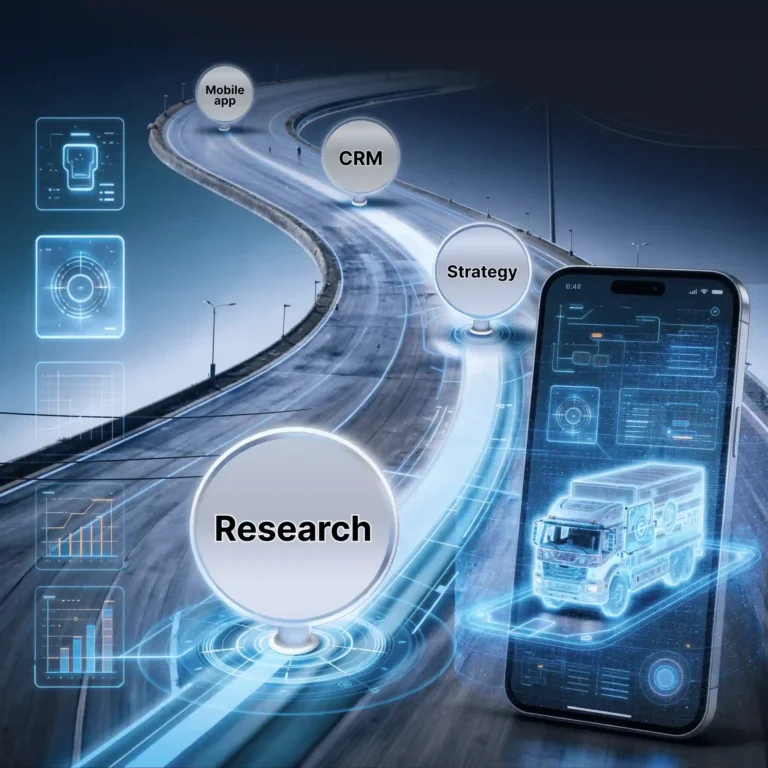
We start with the Discovery phase. Here we work together to clarify the real task, the constraints, and the criteria for success. This is the point where we verify that the task is correctly formulated before we start solving it.
Then development moves in iterations, with a concrete result in each phase. You review reports, give feedback, and the next stage takes your comments into account. This way, the solution is built step by step, and you have the opportunity to influence it along the way.




IWIS development principles